Showing posts with label grahamstown. Show all posts

Sunday, April 27, 2025

(re)visiting South Africa

This year late winter in southern Portugal saw the wettest weather is has seen in something like 20 years.

We made pretty quick work of the 5 tonnes (2.5 cords) of firewood that I had accumulated over last summer and by March it was apparent that we would probably need to get more wood to see us through untill the summer heat was enough to sustain the hot water tank heat from the solar vacuum tubes.

The rain was not a steady persistent soak, but rather downpours interspersed with bright sunlight yielding beautiful clouds and rainbows which we admired on our evening walks. 

Double rainbow from our house

I met an American last year who lives a couple of towns away from ours and who lived a couple of towns over from us in the USA (Topsfield, MA).  He also has a prolific catalog of songs that he can play on his acoustic guitar and so I have found an avenue to explore rediscovering music that I used to play in school and college.  He is a little older than me but our list of songs intersects quite well and his broad knowledge of folk songs has helped me to rediscover the list of songs that I lost somehow on the way.   We meet for a few hours a week and jam together and in some cases working a little on arrangements - though for the most part it is just to enjoy making music together.  

Evening sky in our town

Anne and I love hanging out in our small hamlet and to be honest our sense of inertia has been pretty strong.  Neither of us have really felt a strong urge to go anywhere other than our walks (most days), taking more pleasure in pottering around at home.  

Cumulus clouds on our evening walk

Friends we have met in the Algarve were going off on amazing tips to various exotic places and we had in turn been discussing plans of our own to visit either Namibia or Morocco with the expectation that we'd go to one this year and the other next year.  

By March though, it was looking as though neither of those trips would materialize this year.  We had had several conversations with our friends and family in South Africa leading up to these plans which led us to ask ourselves one evening why we shouldn't go to South Africa?  

To be honest this is another instance of not being fully adjusted to me being retired.  A 3 week trip to South Africa at short notice would have been unthinkable while I was working and we had found it hard to make trips to South Africa while I was working - leading to 2 gaps of 5 years followed by a gap of 7 years (with COVID) between visits.

So once the idea had taken hold and despite this nagging feeling that we wanted to just settle in at our new home, Anne got stuck into figuring out the best routes to use to make a trip to visit.  

We called our surprised family and friends to tell them that we'd made bookings for a few weeks time.  In retrospect the timing was not great for everyone but we were very happy that the adjustments that were needed to accommodate our trip in the midst of everyone's daily life were possible.

We spent a week first in England visiting our daughters and grandchildren.  This is always fun.  We slot into walking the children to school and having walks with our daughters and their dogs to the local coffee shops along the Thames.

A surprising sign along the river reminded me of British optimism.  The Emergency Throwline is in a locked box with a combination lock.  The rescuer on the banks of the river has to call a number to get the lock combination which opens to reveal a bag and rope and a 5 step process to inflate the bag and then throw it to the drowning person while remembering to hold onto the other end of the rope.

Thames rive life saver

 Luckily we never had to test how long a drowning person is able to wait for you to figure all of this out.

We took a trip into London with our daughters and their girls, leaving the younger boys at home with their dads.  Our grandchildren are getting so big.  We keep having these double-takes as we remember what we were doing when we were their age and their parents' ages.

London pedestrian bridge
 
My siblings all live in Gauteng and Mpumalanga and we had a week of catching up to do with my brothers and sister and their children (and grandchildren).
 
The ubiquitous rolling blackouts that left homes without electricity have more or less stopped.  It seems that government funds are being used to improve electricity supply reliability.  This is an area that was neglected for decades.  
 
Many people who had the means have installed solar panels which has meant that the regular funding from households paying for electricity has slowed down enough that there are rumors that the government will attempt to levy a tax on home solar electricity.  When I asked about this the idea was mostly met with skepticism mainly because of how hard it would be collect such a tax.
 
We were struck by the obvious problems with the road and water infrastructure in the small towns up there.  It turns out that this is a general problem in towns in South Africa where the municipalities have not kept up the maintenance of the water pipes and the roads over many years and these are starting to fall apart.
 
A very common sight at homes are these green tanks called "JoJo" tanks that collect water from the gutters and which are equipped with pumps that pump the water on demand into the house.  Most properties have several of these, often placed under the corners where down-pipes can feed them.
 
JoJo tank
 
Water supply on the other hand is harder to manage.  We heard that in some places the underground maps showing where the water pipes run and where joints are have been lost and pipe failures can cause loss of water to entire blocks for days.  The longest town-water interruption we heard about was 23 days but I'm guessing there are people who have had worse.
 
National roads are still in good shape but in many of the small towns the tar roads were severely damaged.
Pothole photo by Anne
The consensus was that all of these were simply the long term result of money intended for infrastructure being funneled into corrupt town and state officials.  

We heard that the mayor of a small town didn't live in that town, but had moved to an expensive home in a city 100 km away and that the really expensive looking homes in another town belonged to town councillors.
 
People in South Africa are quite amazing actually.  Despite the obvious problems, there is a lot of good humor and friendly banter.  One thing that was immediately apparent to me as someone who left there at the tail end of apartheid was the easy conversations happening across color and status lines.  When we left there at the end of white rule, society had been oppressed to the point where the rest of the population were required to show a great deal of deference to whites.  That has dissipated and although I suppose it is still present in some quarters, up in the North East I felt the change in how people engaged with one another.  Respectful and as equals.
 
That is not to say that there is no sense of threat over there.  My sister was quick to warn me not to walk in certain parts of their town and we were careful where we parked.  Petty crime and sometimes very threatening confrontations do happen with criminals.  I think what has changed there is that the privileged white population no longer enjoys the protections that they had under apartheid.  The crime is experienced equally by all races and it affects whites a lot more than it used to.
 
My grand-nephews were willing participants in light painting with my camera using a long exposure and we took turns to make images with each of them.
Alien life form light painting
 
After visiting my siblings we stopped in the Eastern Cape which included an amazing trip to the Winterberg mountains which are north of Makhanda (formerly Grahamstown).   A friend of mine owns some land there and has designed and built an amazing log cabin using the large poplar trees on his property.  He also has an observatory there from which he takes magnificent photographs of deep space.
Night sky and log cabin in the Winterberg
 
Grahamstown also shows the ravages of inefficient and corrupt governance.  The town has had multiple failures of their water infrastructure and outside the main roads, most of the in-town roads are full of really bad pot-holes.
 
There are wild donkeys that roam the streets now and rifle through trash bags if they find them and every day you have to slow down in your car to let the ambling cows cross the road.
Cattle in the road in Makhanda

We heard that in 2015 the town was voted the best municipality in the district with around 90 staff members.  There are now over 1000 staff in the municipality and not much to show for it excepting draining the city coffers.  
 
From Makhanda we traveled by car to Addo, a town on the way to Port Elizabeth.  We had booked an afternoon tour of the nearby Elephant park.  We were lucky to have booked off-season and mid-week so we ended up being the only people on the game drive.
 
Our guide was incredibly knowledgeable and he pointed out a number of animals that we would probably not have seen if we were on our own.
 
Two ostriches with their chicks
Lions resting in the shade in the late afternoon

Warthog and its piglet 

Giraffe 

Cape Buffalo

And so many elephants.

Elephant in the fading light
 

Most of the animal sightings were really up close.

Lion walking past our open tour bus
 

After Addo we drove along an inland route to Knysna, through some small towns that seem to be in much better repair than the previously visited small towns.  We had heard that some of these towns have taken it upon themselves to manage their own district properly and it was very evident.

Some of the towns seemed to have vacuum tube driven solar heat for hot water on every house in the poorer township which is likely from an efficient execution of a government program to provide hot water to poorer homes.

Township houses with solar heated water
We spent the night visiting friends in Knysna and then flew from George on a small plane to Cape Town for the last 10 days of our trip.

We ended up meeting with friends that I haven't seen for at least 12 years and reconnecting with people from my university days at UCT (University of Cape Town).  We also met Anne's friend who we had seen in Seville and other friends from our Grahamstown days. 

Driving home one evening from a movie night in the city,  I took a photo of the floodlit mountain from there.

Table mountain illuminated

My recent plans to gather together music that I have played and sung over the years inspired me to ask our friends in Cape Town who were hosting us if they could find a second guitar that would allow us to jam a bit.  We ended up playing a few songs off and on and then taking the guitar on a trip into the Cederberg which is a spectacular remote place a few hours drive north-west of Cape Town on the Namibia road.

Playing guitar outside our cottage in the Cederberg

 
We went on a couple of walks, the most impressive of which was a hike to the Cederberg arch.  The entire route is along corridors of the most amazing rock shapes - many of which have eerie human and animal shapes that at times make the place seem like a magical land where creatures have been turned to stone.
Cederberg arch

We also stopped at an area called the Stadsaal (Town Hall)

One of the many caves at Stadsaal

with amazing cavernous features, similarly mystical, made more so by the presence of some ancient San rock art nearby.

San rock art in the Cederberg

The Cederberg has very dark nights with very little light pollution and following a tip from my astro-photography friend I set up my camera one night to take 2 hours worth of photographs of 20sec each pointing the camera up at the milky way.  

The result is what is known as star trails.  The successive photographs each capture the orientation of the camera as the earth rotates and therefore captures the stars successively making a circular trail across the sky.  You combine all the photos with an astrophotography application on the computer afterwards.

Star trails in the Cederberg
We traveled back to Portugal incredibly happy that we had taken this journey.  There are so many people we love who we left for all those years.  We've decided to visit again soon.

Two days after arriving back we had the massive 11 hour power failure that affected Spain and Portugal.  During that evening I decided to redo the night sky star trails in the nothern hemisphere.  It was very dark that night.

The northern sky has a single star that is at astronomical north.  It amazes me that the southern sky doesn't have one that is bright enough to register and therefore you see a small circle of the stars that do shed enough light.
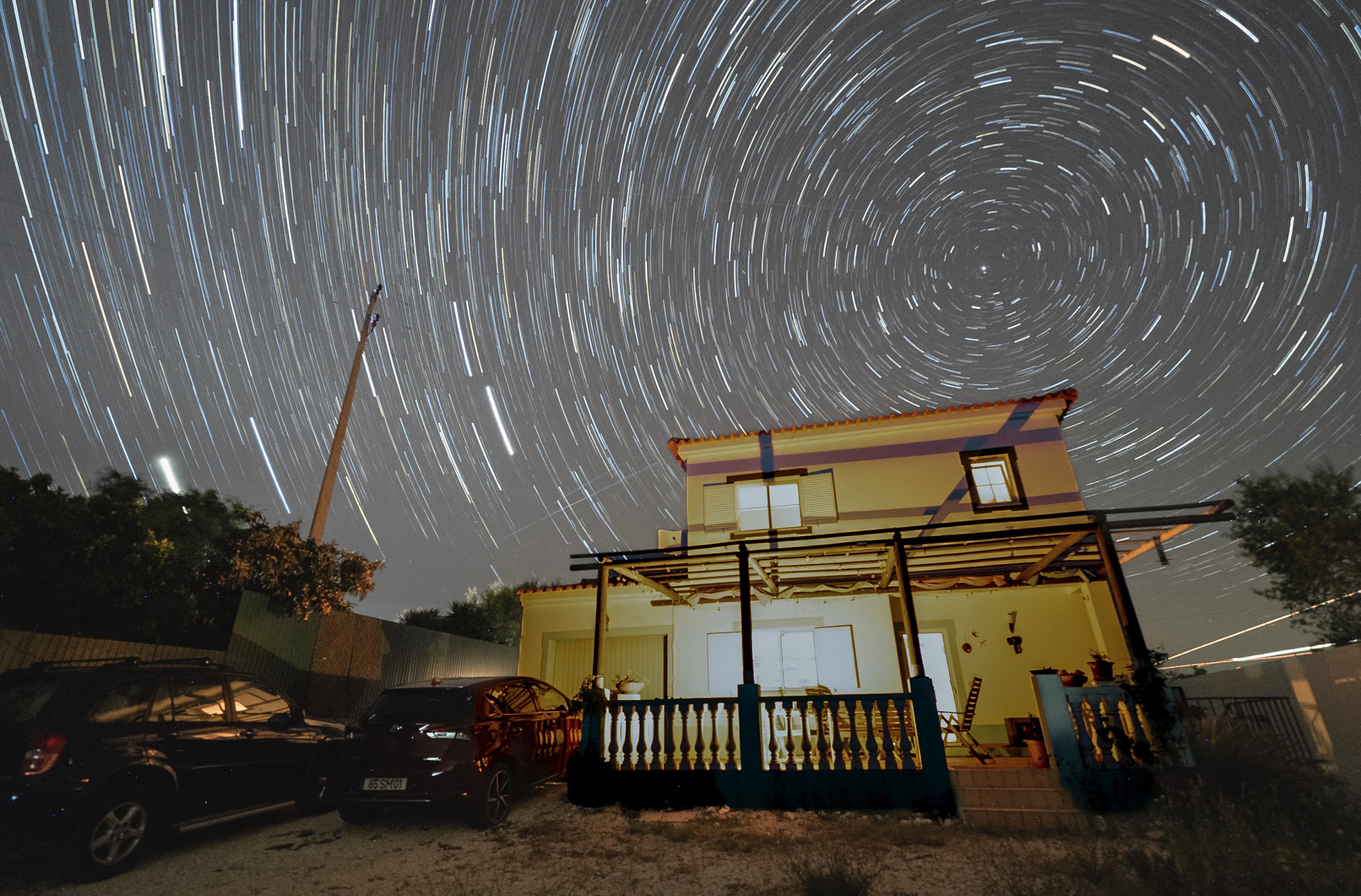
Northern star trails with candlelight in the house
 

So after being so reluctant to move from our new spot, we ended up going on quite an adventure.  One that hopefully we'll be able to repeat before too long.


Wednesday, March 22, 2023

Threads: Kimberley, Grahamstown and Santarem

I grew up in Kimberley - a city in the middle of the Karoo with hot summers and cold winter nights.  Most of my social life revolved around the English Baptist church where we spent a great deal of time on Fridays and Sundays.

Of course the attraction of this social life involved the normal dynamics of teenagers hanging out together and we had a group of friends that we cultivated over those years and then lost touch with once we all moved on.  When Facebook exploded onto the scene in the early 2000's I reconnected with a few of them even though our lives were far apart and we had evolved into people in some ways quite different from those young kids teasing and joking with each other at church gatherings.

Among these friends were two attractive girls with infectious laughs whose parents were Portuguese.  Their mother who was very direct, taught me how to greet people in Portuguese when I visited them a few times at their home.  I've been using those few words quite a bit since we made the trip to Portugal this month.

I had reconnected briefly with both of them when we were living in Grahamstown about 8 years after I left Kimberley and then lost touch again when we moved to the USA 15 years later.  At some point I learned that Armanda, the younger of the two, had moved to Portugal.  So before we left for Portugal I made contact with her through her sister-in-law, because neither of them are on Facebook and Anne and I asked if we could add a stop to visit her on our way down from Porto to the Algarve.

But first we spent a total of 8 days in Porto, taking time to visit the center of the city twice - the first I have written about in a previous post. 

The second trip was to see a famous bookshop that had been a frequent stop for J.K. Rowling when she had taught English in Porto years before she wrote the Harry Potter books.  The bookshop is described as the most beautiful in the world and it has a reputation for being the inspiration for some of the settings described in the Harry Potter books.  On any given day there are lines of people waiting to go inside for an Instagram moment.

You can get a ticket to visit online for 5 Euros but it can be used against a book purchase so entrance ends up being free if you buy a book.

The entrance to the bookshop has beautiful wood panels and elaborate carved stairs curving up to the upper floor.  Despite the crowds, we were able to make our way through the shop and Anne bought a couple of books while I photographed the interior.

A large silver display booth houses a framed letter from a 19 year old Robert Zimmerman (Bob Dylan) to a woman named Barbara describing a dream he had had about her.  It turns out that the bookshop paid over half a million dollars (which was more than double the expected price) to win the collection of 42 letters at an auction in the USA.

Our feelings about Porto were a little colored by Anne getting sick and the fact that it rained for most of the time in an AirBnb that appears to be less than waterproof but we did have a few sunny days at the tail end and were able to walk daily along the long beach of Matosinhos (pronounced Mah-tuzi-nush).

The waves were pretty wild, breaking quite a bit further out than those we'd seen on the south coast of Mexico.  There was lots of evidence of surf schools and it seems like a beach very well suited to that.

A walled structure at one end of the beach is a castle called Castelo do Queijo which is thought to have been built by the Celtic tribe called the Draganes who arrived in the 6th century.  Porto has emblems showing a dragon in various places and their football (soccer) team is nicknamed Dragōes probably after these original Celts.

The view of the beach from near this structure is impressive and we spent an hour walking there and watching the waves on our second last day.

The Friday I took a day off work because Armanda and her husband had invited us to stay with them and I figured it would be pretty rude to spend that night working.  We caught a train from Porto to Santarem - a two and a half hour trip through some countryside that reminded us of the west coast of South Africa and of the countryside outside of San Franciso.

We pulled into the small station and were picked up by Armanda and her husband Luis, and taken to their home for lunch and some conversation before heading out for a walk around the town.  Armanda has not changed at all, other than the greying of her hair, and it amazes me how easily we reconnect with people we haven't seen for years - so much common ground and history that ties us together.  They are such a lovely couple.

We took a walk through the town and there was a sense of tranquillity there.

I suspect some of this is problematic because, like many small towns in Portugal, it is suffering from a drain of young people who are attracted to working in the cities.  They have as their pick more or less any city in Europe as long as they can overcome any language barriers.

So, in addition to the somewhat empty streets there were a few that had evidence of many shops that had closed down and were shuttered.

The walk took us past a few old buildings and into a few beautiful cathedrals to a small park with stone walled structures called Portas do Sol (doors of the sun) 

which look out over the river Teju (Tagus in English) which is the main river of Portugal - originating in Spain and providing the wide deep river that the Romans used to establish the port of Lisbon.
There is a building called the
Torre das Cabaças because it has eight calabashes (gourds) mounted on the tower - local lore has these as emblems of displeasure by the king who reputedly did not like the structure when he saw it but the Wikipedia entry lists these gourds as amplifiers of the tower's warning bells.

On our way back we stopped at a really old Gothic cathedral where a young man gave us an impromptu tour. He was so earnest and engaging that I called Anne into the church just to listen to him. 


Outside on a wall opposite the cathedral we saw some very stylized graffiti which appeared to be a comment on the Portuguese colonization of Brazil. 

We sat at a small coffee house in the evening near the main cathedral.  Lots of young people nearby were playing cards and having a great evening.

Portugal and the town of Santarem experienced major political upheaval in the mid-70s during the Portugal Carnation revolution.  It was a military coup organized by left-leaning military leaders who led the country to democracy and hastened the end of the colonial wars that Portugal was fighting.  Luis experienced this first-hand as a young 14-year old, with factions in a popular resistance that emerged during the revolution.  He has stories about some tense moments with protestors in the town and near his house.

These threads reach back to Kimberley too, though.  In the mid-70s a teenager came to our church after his family was exiled from Portugal.  They had left with nothing but the clothes on their backs and ended up in Kimberly.  The fall of the dictatorship in Portugal and the new left-wing government had taken steps to withdraw from their colonial wars in Mozambique, Angola and Guinea-Bissau.  We became friends and have lost touch - but we used to hang out with Armanda and her sister as well.

The rest of the weekend was a whirlwind of conversations about work and politics and vacations, interspersed with trips, one to a Knights Templar castle inland from us - which the King of Portugal had protected when their order came under threat for being too powerful by renaming them the "Order of Christ".   


He appreciated the protection that they were giving to areas of his domain.

The castle is built on an island in a river, giving it a natural moat, and looks imposing from the viewpoints on either side.

We visited a quaint town on a hill with a beautiful cathedral


and then a stop at a huge dam that now holds back the river
Teju further upstream, reducing the number of floods near the town of Santarem.
Luis and Armanda drove us to Lisbon on the Sunday with a detour to the walled city of Obidos, an ancient walled city that was having a chocolate festival.
Luis navigated the narrow streets and found us parking on the far side of the city from which we walked to an entrance and then down one of the main streets with some beautiful stores,

some selling the famous cherry liqueur Ginginha (or Ginja).  
The city is build on an original Roman settlement and was taken by the Moors in 713.

They built fortifications and the city was retaken by the first king of Portugal where legend has it that a single knight was responsible for breaching the walls to aid the conquest of the city in 1148. 

We climbed up to the walls and the teenager in me was imagining what it took to defend a fortification like this. 


The passage along the top of the wall had a perilous drop behind it and I imagine invaders who managed to get onto the wall were encouraged by many hands to keep going and fall to serious injury below.

The drive to Lisbon featured similarly familiar countryside, rolling hills and green fields.  We stopped at a beautiful lookout over the ocean and a beach on the way down to Lisbon.


First looks of the city of Lisbon revealed tall, tightly compacted apartment buildings.  We spent a night in Lisbon before our train ride to the Southern Coast.

Armanda taught Jessica in Sunday School in Grahamstown and has a photograph that Jess took to her with "love Jessica" on the back written in her 6 year old hand with a green felt-tipped pen.   

It was wonderful to pull on the threads that joined us through all of those years and places.