Showing posts with label cdmx. Show all posts

Thursday, January 12, 2023

Mexico: Ritual violence

During one of our meals in Mexico city we had a soup called Pozole which has shredded pork and corn in it.  Matt casually asked me if I knew why they used pork - and then told me that the soup is a traditional Aztec soup ritually prepared as offerings to the gods with sacrificed human flesh.  Since pork is the closest you'll get to that taste, it was substituted when human sacrifices were no longer a thing.

I have to admit that this stuck with me for days and when we took a tour of the famous Mesoamerican pyramid near Mexico city a couple of weeks later we were treated to more horrifying detail by a guide who took us around for a small fee.


But first, we had bought the package that included a balloon ride over the pyramids, 


followed by a hot breakfast and a tour of an artisanal craft market before going to the pyramids.


This was our first balloon ride ever and Anne had to bail from the experience because of her stomach bug so we invited Gina, a friend of ours also working in Mexico, to take Anne's place.

The takeoff and fight over the pyramids was so tranquil and peaceful


but the landing was pretty stressful because the comfortable large field we appeared to have been heading towards passed by to our right and we ended up landing in a small cultivated patch of land, much to the disgruntlement of the farmer working on  his crops. 

A second balloon came careering in and almost ended up in a tree and then some telephone lines before an eventful landing.


The ground crew managing the landings are impressively adept and quick-minded to steer the balloons in the last minute or so, so that they land snug in the trailer that will take them back to the launching spot several miles away.


After breakfast the trip to the artisanal market brought us to where we were shown a traditional drink called pulque (pronounced pull-ke) which has 5% alcohol and has been used as a sacred drink since the time of the Aztecs.  The taste is a little sour but not unpleasant.  Also on show were amazing hand-crafted obsidian masks, mirrors and sharpened implements as well as locally produced silver jewelry.


At then end of the tour we were approached by a smooth-talking man who convinced the three of us (out of a busload of tourists) to pay $225 (pesos $11 US) each for a guided tour of the pyramids which was well worth it - excepting that I don't remember as much of it as I wish I did.

A number of times I thought to myself - remember to google this afterwards, only to find that a lot of what he was debunking in his presentation was what was reported in the descriptions from 2018 and earlier that I found.  Of course it is possible that his facts/suppositions are not supported by archaeologists  but I'll mention a few that were mind-blowing to me.


The site was named Teotihuacan by the Aztecs when they arrived and discovered these pyramids built hundreds of years before them and decided that this place was where the gods were - and named the two prominent pyramids the temple of the sun and the temple of the moon.  It is thought to have been created between 250BC and 1BC but the civilization that created it had abandoned it by around 650AD.

There is evidence that the creators of these pyramids had sophisticated math which included two calendars and knowledge of the phases and orientation of the moon which influenced the architecture.  From a platform in the middle of the central square you can see the full moon rise over 13 separate smaller pyramids.  The calendars are embedded in the number of horizontal tiers in the pyramid (91) - 4 of these multiplied = 364 and each combined provide days until planting, days till harvest as well as a combination of 3 of them the time for gestation of an human infant.


The base and height of the pyramids have the ratio of pi and there is a carving in the middle that had a line to delineate the deviation of magnetic north from true north (based on the north star).

But this is where it gets weird and horrifying.  The cultures that existed around this area practiced ritual sacrifice.  There is evidence uncovered in archaeological digs here that society was divided into different groups - warriors, farmers, artists and "those to be sacrificed" where, with permission of the whole community, people were identified at birth or soon after to be sacrificed for religious rituals to ensure that rain would fall and that the people would remain powerful.

The guide said that in these earlier civilizations it is likely that these children were treated as royalty until they were sacrificed.

The lines get blurry here for me - because the Aztecs when they arrived took these practices to the next level.  For them sacrifice appears to have become very regular and was not always volunteered by parents and the community but was inflicted on captives and other members of the community in cruel ways.

Anne had visited the anthropology museum in Mexico city and has seen horrific implements and a table with a cavity in which human hearts had been placed after ritual killings.

Our guide pointed out that there is a difference between cannibalism for the pleasure of eating humans and ritualistic cannibalism where, for example a warrior's heart was eaten to get his strength or a violent criminal was served for dinner to a family who had been the victim of his crimes.

We had a somber walk back to the car after hearing about all of the beauty of their art and mathematics and then the brutality of their offerings to appease the gods.

At the end of the walk our guide mentioned a woman who had married a Spaniard who had ended up in Central America (the Vikings, Chinese and Spanish had apparently made it across the ocean to this region centuries ago).  She had learned the language of the Mayans, Aztecs and Spanish and had suffered the brutality of Aztec rule to the extent that she helped the Spanish convince all of the subjugated tribes in their kingdom to rise up and defeat them - leading to Spanish conquest and pillage of all the wealth of the rulers.  As is always the case the details are more nuanced than this when you read up about it.


You are no longer allowed to walk up the largest pyramid - they have found seismic cracks in the top and 3 recent incidents where a person's pacemaker stopped from magnetic energy of some kind and two hikers had collapsed after taking on the steps without proper regard for how strenuous an effort it would be.

I was happy to comply.


Tuesday, January 10, 2023

Art and violence


I mentioned in a previous post the art of Diego Rivera and the artist Frida Khalo who sheltered Leon Trotsky for two years before he was assassinated in Mexico City.

We visited the Frida Khalo museum which is in the house where she grew up and then owned with Diego Riviera. 

The house is known as the blue house for obvious reasons and has a beautiful garden and water feature in what appears to be a wealthy suburb of Mexico City. 


I was struck at first by how big it is.  I supposed that her family were probably fairly well off when she was young.  She was in a devastating collision during a bus ride in her early 20s and among other injuries a pole in the bus pierced through her lower back and out of her groin. 

Doctors where unsure of her chances for survival and over the years she had over 30 surgeries but she was never able to escape the pain in her back.  


Her art embodies this pain and the violence of an abortion and later a miscarriage that she suffered because her body was too damaged to bear children.

Later in her life,  Diego paid off the mortgage on the house, which allowed it to stay in the family so that when she returned there after divorcing Diego it eventually became hers.

She was a very strong person and her art was unique for the time.  She deservedly gained world-wide fame in her lifetime.

We re-watched the film with Selma Hayak which was filmed in the house and gardens (although I suspect a studio set was used for the earlier years before Frida had it painted blue).  She decorated the inside with so many small details that all made the visit well worth it.

For example there were two bedrooms for her near her art studio - the first, a day bedroom (for when she was in too much pain to get up) has a portrait of a dead child above the bed with a garland of flowers and now has her death mask surrounded by a shawl which museum docents change each season as she would have.  Under the canopy is a mirror that allowed her to paint self-portraits without having to get up.
 
 
In the second bedroom (her night bedroom) she had a display of butterflies mounted above her under the canopy.  The cushion on her says "Despierta mi carazon dormido" (Wake up my sleeping heart) which she may have embroidered for Diego - it had previously been on a chair in his bedroom.


Diego's bedroom is downstairs next to the dining room and had one of the two bathrooms that Diego closed off to the public and in which were some things that he had sealed from the public for 50 years after her death.  The bathroom is behind the green door in his room.
 
 
When they were opened they revealed among other things letters that she had written to her doctor, a confidant and friend - expressing her sorrow at not having been able to have a child and also his urging her to reunite with Diego who he said had three loves:  her, painting and other women but that he loved her despite being incapable of being monogamous.

Afterwards we took a walk down the road to an appropriately death-themed restaurant called La Calaca (the skeleton) in Coyoacán where an old couple were serenaded  by a mariachi band for their anniversary while we ate. 


Sunday, January 1, 2023

Megacity problems

A trip into the center of Mexico City was a pretty quick way to experience one of the problems of being in a megacity. 

The plan was for me to skip lunch at work and leave late afternoon to visit the museum of art in the central historical district.  Uber rides are plentiful and cheap in Mexico city and we were able to easily get to where we needed to go from our AirBnb in the suburb of Escandon (a 15 min drive West of the center).  

First the museum


The museum (Palacio de Bella Artes) had a fairly long line of people waiting to get in and we were a little surprised and disappointed to discover that the only areas accessible to us were one exhibition of the work of Federico Silva, and the walls of the main atrium - 3 stories high.


The art on these walls were murals by famous Mexican artists, including Diego Rivera who was married to Frida Kahlo (who is one of Anne's favorite artists).   

Anne and Nick taking photos of a work by Federico Silva

The Rivera murals from the 1930s depict emerging communist heroes and mock white tourists and the police and government of Mexico in various panels - reflecting the political and social corruption of the period that motivated his interest in communism.

Diego Rivera and Frida Kahlo sheltered Leon Trotsky during his exile in Mexico for 2 years (1937-1939) and she became his lover during that time.  

The mural of an artist who hated Trotsky and who attempted but failed to assassinate him hangs across from Diego Rivera's murals, prompting the museum guide to point out that the museum's halls had an artist who wanted to save Trotsky, another who wanted to kill him, while Frida just wanted him.

Carnival of Mexican Life Polyptych - 1936

Diego created a commissioned mural for the Rockefeller center in 1932 as a portrait of a man at a crossroad looking in high hope at a vision of the future.  His original sketch was not very confrontational but Diego was criticized for being a sell-out by leftists in New York.  

When he actually created the mural he more or less ignored the original sketch altogether. 


Rockefeller's son said that his father is depicted sipping martinis with a harlot (along with other unflattering things) while Lenin is depicted on the right (other communist figures including Trotsky and Karl Marx appear on the far right).  Rivera was asked to paint over Lenin and refused, saying he'd rather the artwork was destroyed than mutilated and it was ultimately chiseled off the wall in New York.  Later the mural was recreated by Diego in Mexico.

Then the crush of people

After the visit to the museum we walked up a block or two to the central plaza in the historical district called the Zócalo. 


We had a really fancy meal in a restaurant nearby and then decided to make our way back to Escandon.

Admittedly it is the week between Christmas and New Year but I was instantly reminded of the crush of Halloween celebrants in the little walkway near the Peabody museum on Halloween weekend (multiplied by thousands).


Every public walkway (broad streets closed to traffic) leading away from the Zócalo was full of people making their way in and away from the center and every street perpendicular to these was full of back-to-back cars trying to make their way along.

We were shell shocked within a few minutes, trying to figure out the best way to get out of the city.

Nick suggested that we walk a few blocks until we came to a major road that was not gridlocked with traffic.  I was struck by some of the shops including one that sells clothing repurposed from used clothing and one with clothing hung in layers a story high on the wall outside.


As we we walked, the crowds did not diminish but the setting became less glitzy and gradually less appealing and we eventually huddled on the corner of a gridlocked side-street and a main road waiting the 9 minutes or so for an Uber to make its way to us.

Megacities

I was surprised to read that of the top ten megacities (population over 10million) only one (New York, 23 mil) is in the United States.  Wikipedia sources an article with population figures published in Jan 2022 which shows that London reached this threshold in 2020 (14.8mil) with Johannesburg (14.5mil) making the threshold between 2020 and 2022 which is a phenomenal rate of growth.

The articles about megacities point out that the problems are exacerbated in less developed countries.  

Sanitation and water delivery are two major problems as are societal issues associated with crowding: transport, slums, crime, air pollution.

Mexico City has its share of additional challenges including being in an active earthquake zone.  The country is the region with the most severe natural disasters worldwide including volcanos, tsunamis, hurricanes with earthquakes with the three most recent in the city being (Sep 2022, Sep 2017 and April 2014).

As a result of earthquakes and lack of maintenance of the infrastructure for delivering water, the city has been using (and losing) more water than the underground aquifer that delivers it can provide.  The draining of the aquifer is reported by Latinamerica Reports (Sept 2021) to be causing the city to sink by 20 inches (50cm) a year.  

Sanitary waste water treatment challenges make it hard to keep the water that does collect during rainy seasons clean and the crumbling water delivery infrastructure is leaking a staggering amount of water back into the soil.  Currently around 20% of the population only have access to running water for part of the day.

Water 

Not even the locals drink tap water in the city and there are plenty of warnings online about drinking tap water.  Some people will avoid wetting their toothbrush with tap water or opening their eyes or mouth in the shower but this is considered unnecessarily cautious by most.

There is a major industry with drinking water, some large 5 gallon bottles that are exchanged in many of the local shops and smaller bottles that you can buy for about $1.62 US.  We have been carefully washing raw vegetables and fruit with bottled water.

Large blue-capped water bottles stacked at the right

A couple of days before New Year's day we were planning to go to a famous restaurant in Roma where you get a traditional meal served on ochre pottery plates and cooked in a traditional open kitchen.  

The wait was two hours because you can't book and it is incredibly popular and so we decided to go to a small vegan restaurant around the corner instead.

We don't know if it was the fresh fruit juice served there or something else we had that day, but Anne and Nick were both not feeling great the day after when we visited the traditional restaurant again for breakfast.  By that afternoon Anne was flat on her back and what followed was two days of massive headache, nausea and upset stomach.  The standard pills (ibuprophen and paracetamol) didn't make a dent and so she had to ride the storm without help.

Nick had it less bad - he was off his feet for the night and feeling generally miserable for the next day but Anne took about 3 days before she started to feel normal again.

This photo shows a combination of things on the AirBnb counter after New Year's eve:

  • Anne's special water bottle with 0.2-0.01 micron filtration
  • bottled drinking water
  • grapes for the traditional 1grape per each of the 12 strikes of the clock to bring luck in the new year
  • honey for rooibos tea (yes we brought that with us) and 
  • wine for me, watching over Anne as she fought with Montezuma.

Monday, December 26, 2022

First steps in Mexico City


Our sons have described Mexico City as very cosmopolitan and somewhat reminiscent of Europe but at first glance the similarities were offset by a third world feel (somewhat like in South Africa).

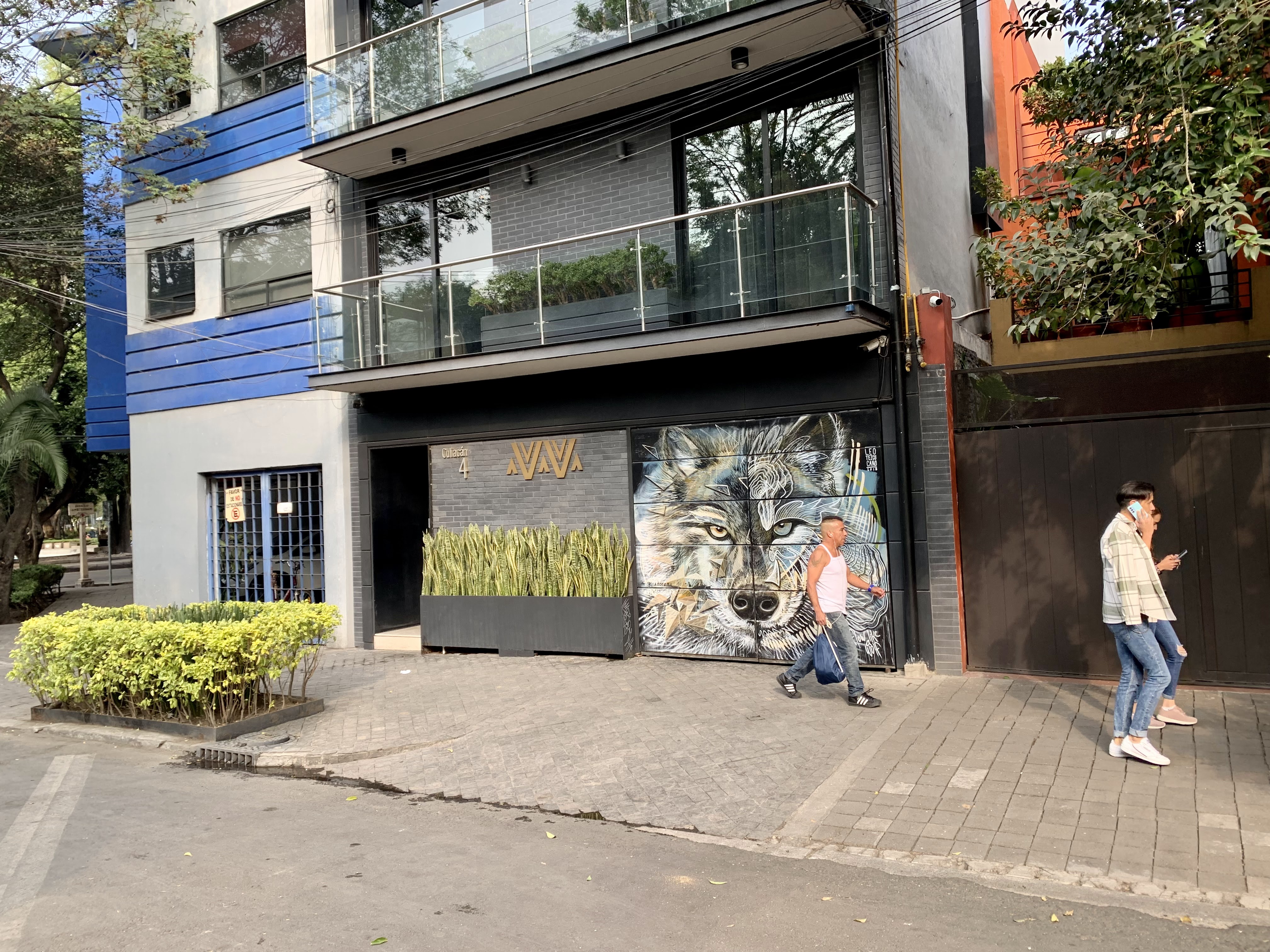
There are streets with apartment buildings all adjoined, between three to five floors high.  

This does feel distinctly European.  Most of these buildings have a roll down door that allows cars into the ground floor parking place - in some cases a car elevator to take cars down to a lower ground floor as well.  In many cases these open garages have been converted into small shops that are brightly lit at night offering street food and any number of services from motor repair to upholstery, pedicures and veterinary care.  

This makes for fairly lively main roads teaming with people for most of the day.
 
Our AirBnb has a small narrow balcony out of a large window wide enough to stand and barely wide enough for a chair.  Wooden stairs take you up to an empty concrete roof that Anne has been using to soak up the warm winter sun.
 
 Most of the apartments have access to a flat concrete roof for hanging out on, entertaining and for hanging clothes out to dry.


The third world-feel comes from peeling paint and graffiti on the walls and from sidewalks that are designed to trip you up as soon as you look down at your phone to see the map.  

There are many  trees in Mexico City.  Great big old trees that have heaved the sidewalk asphalt and cement up in blocks that you have to watch out for.  

Apartment entrances have also contributed to the uneven sidewalk with driveways almost a foot above the sidewalk that force pedestrians to step up to cross them.

There is a distinct smell in the streets during the day.  I think it comes from the corn that is cooked in various forms in the small shops along the street.  Corn in the USA is pretty singular - a sweet corn from what we knew as “mielies” in South Africa - small yellow kernels.  The corn in Mexico is more varied in color and size, and with more distinctive tastes and smells.  
Tortillas - the flat wraps for a lot of street food - are made from corn rather than wheat flour here.  A delicacy is a corn that has a fungus that grows on it - think of it as corn mushroom - that my conservative tastes won’t allow me to try.

The Spanish speaking experience has been unsettling for me.  I was a little cocky after our experience in Spain and I found on the second day how out of depth I was with a short conversation at the reception desk of our apartment block when I tried to ask if they could give us a spare key.

I had rehearsed my question fairly carefully:
     “Tiene usted otra llave para nuestra apartamento” (do you have another key for our apartment, sir)

He didn’t hesitate and said something that sounded to me like:
     “Anwe oirah jak oilklp pwaa aklfl adkflj ppiiw epixaf el airbnb”

I said: “¿Que?” and he repeated the sentence slowly enough for me to catch the “AirBnb” - realizing at that moment how lost I was but at the same time I knew what he was telling me to do about the spare key.  So with a “Gracias” I slinked away to lick my wounds and to tell Anne to contact the AirBnb to ask about a spare key.
 
Two days later I was standing in a shopfront store nor really willing to ask the shop attendant a question in case I had a repeat of the previous experience.  All I wanted to do was to buy a coke!  It naturally turned out to be pretty easy.  I even guessed that the shop assistant had said the price was …. well, somewhere between 20 and 30 pesos!  20 pesos = $1 US at the moment.

I have realized that getting really comfortable speaking the language will come slowly through regular repetition of day-to-day things like greetings and ordering food or shopping for household things - later we might start to practice small talk but that feels a long way away.

Our sons are both so fluent it is scary.  I asked them to try not to help us and they too have waited patiently for us to form sentences with butchered tenses and nouns and then left them hanging there for the waitress to work out with us.

We are a few days in, fumbling our way through making ourselves understood.  So far the people we’ve met have been patient with it.  Some speaking English but respecting our continued attempts to reply in Spanish.   The areas we have been in (Condesa, Roma and Escandon) are very cosmopolitan and the people appear to be accepting of people with different lifestyles - and we’ve been treated with good humor.