Showing posts with label England. Show all posts

Saturday, September 16, 2023

Portugal mais uma vez (once again)

After Cornwall we took a train ride up to Manchester to see our friend, Stephen.  He lives in Sale, a stone's throw from the Manchester United stadium.

Steve treated us to good food, great conversation and a trip to a massive sculpture garden in Yorkshire, which is about an hour's drive from Manchester. 


We spent time walking in the gardens with his two lovely children and their partners. 


The grounds are extensive and Anne had her fill of the majestic ancient trees. 
Credit: Anne - one of her many photos of the giant trees

Steve drove us back via Sheffield to give us more scenery.  The countryside of England is very beautiful.
 

From Manchester we flew to Lisbon to spend 10 days with our two daughters and their families in Seixal - a town south of the river that separates Lisbon from the south.  We took some time to go to an art gallery in Lisbon and to visit a castle in the famous town of Sintra in the mountains north-west of Lisbon.


but most of the time we spent on a few beaches near to our AirBnb - one of which was particularly well suited to swimming despite fairly large waves breaking off shore.

We were still feeling pretty thrown by how much we liked the atmosphere and countryside of Cornwall, Devon and Yorkshire and had some hard thinking to do to decide between living in the frequent rain and damp with the short winter days of England and the sunny, mostly mild climate of Portugal.

The tradeoff is pretty miserable.  A place that you feel such a strong affinity with vs a place where the weather is mostly great and your life is calm and relaxed - but you are an alien and part of a group that is becoming increasingly problematic to the local population.

Of course there are plenty of other considerations - it is much more expensive in England and Portugal has this rough feel to it.  Sections of any town or street are a little run down or crumbling and the open areas during the summer are mostly dirt, not grass - like in the Kalahari.

A small river resort near the little town of Alte in the Algarve
 

House prices have climbed in Portugal to a level that seems to defy us finding something comfortable to live in - there are plenty of ruins selling for the price we are looking for and good homes are quite a bit above our limit.

on the market for 250 000 Euros
But we have started searching in earnest now, hoping to find an house that is an outlier - a gem or something that'll just do for us.  We hover somewhere between despair that we'll never figure this out and cheerful optimism that we might.  

Fortunately there are two of us and we tend to balance each other out.  One of us might be in the doldrums and get dragged out by the winds of optimism of the other or visa versa.

There is also plenty of paperwork and bureaucracy still ahead of us, the visa we are going to apply for requires that you have a property already or a 12 month rental in place.  Unfortunately most owners are happy for their houses to be available only for holiday makers in the summers and there are very few long term rentals to be had - and a mob of people trying to get them.  Even if we could persuade someone to rent to us they won't offer more that 6-8 months of rent when we actually need 12.

So the other option is to buy a house and then apply for the visa.  We found someone very knowledgeable who could help with assessing and buying houses in the Algarve, who would work with us to try to get a good deal.  He failed to impress though, having forgotten to mention, when he met us and persuaded us to stop communicating with other realtors, that he was leaving for two week's vacation the following day.  We waited to get started on the project with him and after not hearing from him on the 2nd day after he had said he'd be back, it dawned on us that his enthusiasm didn't match ours.  

I wonder if our budget is discouraging to someone like him - he stands to earn significantly less with a 2.5% commission on the much more expensive homes that are on the market in the Algarve.

Working with realtors is the pits.  You have to work with them with very little trust, knowing that the bottom line for them is pretty mercenary.  I imagine their sales training is like: find out what they can afford, get a rough idea of the characteristics of houses that they are looking for and then coax them to buy something about 20-30% more expensive than their limit from your portfolio even if it isn't a fit.  Oh and also if they ask about any details that matter greatly to them just give them a positive answer even if you know the answer is bad.  Who else sells like this?  I'm reminded of the father in the Roald Dahl book, "Matilda"


Trying to organize our viewing schedule and summary of properties

Our plan is to continue searching until the end of October.  Anne is doing most of the work and we need to schedule viewings in the mornings outside of my normal working hours.

If we haven't found a house by November we will need to find some other way of proving that we have at least 12 months secured rental in Portugal so that when we return to America we can start the process of applying for the visa from there.  It can take several months and even then, there are unknowns in terms of what documentation the embassy might require from us which might cause additional delays.

Our current AirBnb's have been in Faro and Olhão - they are pricey still because we are at the tail end of the summer season.  Hopefully we'll be able to find something cheaper for October.

We took a ride last weekend in a solar powered boat in amongst the small barrier islands that separate the sea from the land near Olhão.  

The wetlands formed by these barrier islands are home to a variety of bird species and it was a pleasure to motor around more or less silently and photograph some of the birds.  

Not far away from here are salt marshes that are an active sea salt mine and which attract a large number of flamingos at certain times of the year.  We saw them in March in Tavira and will no doubt see them again if we can manage to get permission to stay here for longer than 90 days in each 180 day period (the current visa constraints for US and UK passport holders).

The AirBnb in Olhão is right next to a nature reserve with a research station for sustainable fish farming where they are researching ways to replenish the dwindling fish population.  We took a walk around the natural park.  It is dry and warm and felt a lot like a walk in the veld near Kimberley.  There are two blinds on the property - one looking across the salty wetlands and the other over a depleted fresh water vernal pond. 


I imagine in the winter during high tide and when it rains the bird-life would be closer to the blind.

Here's hoping we are back here in the winter with a temporary residence permit and who knows, maybe even a house?


Sunday, August 6, 2023

Cornwall: It is usually much better than this

The AirBnb in Newlyn was a quaint house owned by an old lady who is in elder care.  Her daughter is using it as an AirBnb to fund the costs of a private facility for her mom.  As a result, the furniture, art and bookshelves are full of echoes of her mother's life.  She was a scholar and probably a teacher because we found lots of poetry books and the collected works of classical authors and playwrights in her sitting room with a bay window.

The dining room table was the only desk available and the chairs were severely upright in a completely unforgiving design.  By the third day of our stay I was suffering from cramps in my shoulders from sitting on the chairs with my laptop on the table, a few inches higher than my back could tolerate.  I ended up having to spend most of my working hours on a couch with the laptop on my lap - less strain on my back but not ideal because I have become accustomed to using a small flat monitor alongside my laptop monitor to give me more screen space for work.

We weren't able to book her house for all the time we needed leading up to our first house-sit in the area but our host offered us another apartment AirBnb in a tiny place north of Penzance for a discount.

When we arrived there we immediately regretted not looking at the reviews of the place- we were lulled by how nice the house in Newlyn had been.  Couched in polite paragraphs about it were a few warnings that we would have heeded had we read it.

The entrance to the AirBnb is around the side of a house on the property of a MOT garage (MOT is the shorthand for the annual road worthiness and emissions test in England) and the owner of the MOT clearly has had some run-ins with the AirBnb owner because we were warned not to park in front of or on the parking area for the garage.

From the garage parking lot we entered into a narrow lane and found a large, sunken single room which has a mezzanine built above the bathroom on one end and a narrow sitting room at the entrance. 

There is a fridge but no stove or microwave which meant that we'd have to eat out.  

The house is one of a few on a short, narrow Cornish farm road ending with the MOT and then farmland.   We thought we'd walk to a restaurant on the first day and then saw that the route was 25min of walking along single-lane roads and decided we'd rather drive (which took 20 min).  

We cursed the price of restaurant food and the host for thinking that someone would be happy with an AirBnb with nowhere to heat or cook food.

On the second day we decided to brave a walk along the single lane country road and noticed a woman crossing a stile - a small wooden structure that allows you to step over a fence - into the field and then across it and over a second stile.  

We decided to follow her but when we came to the second stile we were confronted by a herd of attentive bullocks with a massive bull lying on the grass behind them as we got to the top of the first stile.  

We paused, looking at the bullocks, which only made them curious, so they all started to stand up and crowd towards us.  For some reason Anne decided to sing to them at this point which had them even more interested, and then the bull stood up.  The brave woman before us had simply climbed over and walked across this field without a pause, but we, the intrepid world travelers, were frozen on the spot and after a few breathless minutes and when Anne had finished her song, we retreated back the way we had come.

We had one trip on a morning to the town of St Ives which we had to abort because we couldn't find parking and had to make a second attempt the next day, this time parking in Penzance at the train station and catching a bus.

St Ives is a pretty town with a sheltered beach along which there are plenty of little shops selling Cornish Pasties and other street food.  We stopped for an early lunch and heeded the warnings about the seagulls who love to steal food from absent minded eaters.


Halfway through eating my carefully shielded pasty I had a lapse in concentration and the next minute something hit my hand hard and knocked the pasty down onto the beach below the wall we were sitting on.  A screeching colony of gulls followed, fighting over the prize.

I sat there flabbergasted and spent the rest of the time fuming, watching the human adults and children around me eating their pies and waiting breathlessly for one of them to fall victim to these thugs of the sea.  Fifteen minutes later I gave up, thinking I must have been the only klutz there that day and bought another pasty which I ate out of the paper bag as we walked back to the bus-stop for our ride home.

Our next stop was the start of a house-sit in a town called Camborne which is near the northwestern edge of Cornwall close to Newquay but a little further inland.  Because the hosts of the house-sit were leaving early the next morning we had a night where we had to find accommodation and so we spent it in a small bar/hotel in the tiny seaside village of Portreath.

Portreath is very small but has a strong community vibe with a mixture of houses and a rather nice beach - assuming you are willing to brave the weather.  I think it is a sign of the climate that people are out at the beach in large numbers in cool wind and light drizzle as if this is the perfect weather for a day on the beach.

On the way to Portreath we stopped at a monument to a mine owner who in the early 1800's had developed a reputation for fairness among the miners and their families - there were thousands of people who formed a funeral procession when he died and the town and miners collectively raised money for the monument. 

 
The monument itself was not really much to look at but nearby we found a castle-like structure built on a hill with a couple of large rocks supporting one corner of the building.  It is operated today as a restaurant.

Carn Brae castle

The towns inland in Cornwall are a little more run-down.  A report in 2022 identified many of Cornwall's districts as being in the top 10% of the most deprived in England.

Our house-sit was in a housing estate in a respectable area on the outskirts of the town Camborne.  It was a relief to be in a full sized house with a desk and office chair.  

The animals in these house-sits are always a pleasure, in this case two dogs - one of which was crazy active, a small tortoise, an axolotl (an unusual little salamander from Central America) and a large aquarium of marine fish with a really sophisticated system for managing the water purification, temperature and lighting.

True to form it continued to rain most days.  We never trusted the look of the sky and took our raincoats everywhere.  We needed them almost everywhere. 

We were able to take morning trips before my work starts to two impressive locations within an hour of where we were staying - the first being the Eden Project - a project that was started in the late 1990s when a group of like-minded people bought an extensive open mined clay pit in Cornwall and converted it into a large garden and educational center with biosphere's containing plants from a wide variety of climate zones.


A partner of the Eden Project offers an exciting option while you are visiting, a zipline that spans across the project's biospheres.  It is the longest and fastest zipline in the UK.  There are also high wire obstacle courses that are adrenaline-driven entertainment.  We didn't have time to try out the zipline so that one has been filed away for a future visit.

Our second visit was to the Lost Gardens of Heligan, the largest garden restoration project in Europe.  Once a large estate that was mostly self-sufficient, growing almost all of the food needed for the family and their guests (and I'm assuming their staff), the farm was abandoned by the grieving owner during World War I after many staff who went to serve never returned.   The grand house of the estate after being abandoned for 50 years was sold in 1970 but it wasn't until the aftermath of a hurricane in 1990 that events conspired to inspire the restoration.

A small room called the "Thunderbox Room" (a euphemism for a long-drop toilet) that was used by the gardeners was discovered during excavations with penciled inscriptions on the wall.  These were signatures of the gardeners who worked there and had a date, August 1914.  The toilet has been designated a war memorial in honor of their sacrifice during the war.  When we visited it, there was a small swallow's nest in the eves of the toilet just inside the door.  It was full of babies with a parent that was flitting in and out between the frequent visitors' comings and goings.

The gardens are huge - with cultivated fields and extensive vegetable gardens, large playing areas for children and a wild section called the jungle with a rope bridge that is constantly full of the "10-at-a-time" visitors crossing from one side of a stream to the other.

I haven't mentioned this before, but Anne has two small containers that have accompanied us on our travels.  In each are a portion of her parent's ashes that were given to her after they were cremated.

I've worried about them being confiscated by airport security who don't like "powder-like substances" at the best of times.  Anne has done the research and these are on the list of permitted carry-on objects, but we have had things confiscated (like round nosed scissors) that prove that the list of permitted items are mere guidelines in the mind of the security officer regardless of what any airport regulation might say.  Our closest call was evidence after one trip from Mexico to the USA that the small bags had been opened.

Anne has thought that she would scatter the ashes somewhere beautiful that her parents would have loved or where we end up settling but the final decision might be a while away.  In the meantime we know that they would have loved the destinations that we have taken them to.

We (the agnostic and the atheist) also have a small superstition: that our departed family members visit us occasionally.  I suppose it is less of a literal thing than in moments when something profoundly moving reminds us of a lost parent.

For me it started on a weekend out in the wilds of the Cederberg having just got news of my mother's sudden death.  We were hiking and came across a lone butterfly which sat on a bush on the edge of the trail for a long time as I stood there and watched it.  I am still reminded of my mother in moments where I come across a lone butterfly like this.

For Anne, it is the sight of an English robin - the little red breasted bird often seen in the bushes nearby on walks in England.  It unfailingly prompts one of us to say to her "Hey! Here's your mom!".

Anne's father was a gardener.  He loved working in his garden and experimenting with pruning and grafting plants and she had told me that her parents had visited this Lost Garden with her brother on one of their trips to England and had found it absolutely enchanting.

So, as we entered one of the vegetable gardens we saw this scarecrow with a little toy robin stitched to his shoulder and immediately concluded that these were her parents: the gardener and the robin.  

Anne hadn't thought to bring the little bags with us on our outing but we did talk about whether this would have been the perfect spot for them.  I think Anne would secretly prefer to scatter them where we end up and not in some garden that we might not visit very often so she didn't think too long about whether this was the place she should have chosen.

We stopped for one night after our house-sit at a small hotel in Falmouth a short walk from the beach.  The wifi did not reach our room so I had to sit in the bar for the day.  It got a little noisy after 8pm with a number of chatty people who filled us in on the area.  

Most of the people heard our complaint about the weather and said "It's usually much better than this", assuring us that there are many days of warm weather most years.  

Our last stop in Cornwall is the small town of Roscastle which is 3mi away from Tintagel, the supposed birth place of King Arthur.  The town is small with lots of stone walled houses and buildings and our guest house is above a restaurant and bar called The Riverside. 


There are the ruins of a castle across a bridge to a wild rocky peninsula about 3mi away but they were closed on the Saturday of our visit due to the high winds of the first named tropical storm of the season which gave us pause because in 2004 there was a flash flood at around this time of year that tore through the town, flooding on both sides of The Riverside building and dragging parked cars out to sea. 


The harbor, another of these narrow natural inlets protected by stone walls, is a short walk from the guest house with the South Western trail clearly visible on either side as it arches into the town and back out along the bottom of the hill.

Our last Sunday in Cornwall was sunny and clear and we have rebooked for a visit to Tintagel which was described as the birthplace of King Arthur in poetry as far back as the mid 1800's when Lord Tennyson in his poem Idylls of the King described this location.  

The site is significant because it has evidence of settlements going back into the Dark Ages where it was a hub for trade.  There is plenty of evidence of walls from the homes and storerooms from those long gone days but the town is geared now towards the legend.

On the hill of the ruins of the ancient castle (which is also associated with the legend of Tristan and Isolde) is a statue of King Arthur called "Gallo" which was commissioned by English Heritage and installed in 2016.


At the bottom of the hill, a cave which is accessible at low tide is named after Merlin the magician and also mentioned in the narrative poems.

In the town itself is a great hall build by an English businessman who wanted to celebrate and honor the legend - it has many stained glass windows and is itself a draw of tourists.  There is a modern "Honorable Society of the Knights of the Round Table" that is still active today - it was founded in 1720 and is an active charity for promoting the pursuit of the arts and also the scouts organization.

The Knights Templar is also an active organization today doing charitable work and they apparently come to this hall for meetings annually.   A blogger describes the organization but warns that there are some organizations who have co-opted the name to further hate messaging which, given their history in and after the crusades, might not surprise you.

From Tintagel we drove back to Plymouth, leaving the lovely Cornwall behind and leaving us with really mixed feelings about our plans.

Do we trade cool, windy summers and cold rainy winters for the sun and beaches in exchange for a place that we feel so comfortable in and where we know we'll find plenty to do?


Monday, July 24, 2023

Cornwall: there is a reason it is so green

I have a few friends who absolutely love New England winters.  Often this is because they are passionate about winter sports and enjoy getting out on the ski slopes as soon as it is possible.  Hiking in winter in New Hampshire is also an attraction.

I have something amiss with my circulation that makes my body decide to sacrifice my fingers and feet for survival in the cold and so,  a few minutes into a hike I have to spend time coaxing the blood back into my numb fingers and toes.  I think it is called Raynaud's phenomenon and it has made my winter hikes with friends less enjoyable than I would have liked.

If you don't have some outdoor activity that you are passionate about, winters might be miserable.  Anne and  I would  get out for walks every day that we could in the winter often on a windswept frigid beach.

If you ask people who don't have specific outdoor activities in winter which seasons they prefer they'd often explain a preference for cool weather because "you can always dress up for the cold".  Its true that beyond a certain temperature the heat only has a few options for cooling down unless you have air-conditioning in the home.

In Cornwall the climate is very moderate.  The average day-time temperatures range from 9C (48F) in winter to 19C (66F) in summer - with some days that are outliers on either side of this.  The rainfall charts show rain every month of the year with around double the amount in the winter months. 


This means that if you like summers where you have a raincoat and a sweater in a backpack on most outings and you don't mind mud you are in the right place.

Even on the most beautiful days here there are clusters of clouds that  momentarily block the sun and make you aware of how cool the breeze is.

Funnily enough we have found ourselves playing devils' advocate with this because of how comfortable we feel here.  It feels like a place we could settle into rather easily.

So I decided to do some research on how people might choose a place to retire and I came across a blog written in 2020 where the author and her husband decided to use comparative data to help with their decision.  I thought it might be illuminating because although the process of setting up the data is fairly subjective (choosing what matters to you in a place to live, deciding how much weight to give each category) at the end you have a list ordered based on how well a place stacks up to each category.

Anne is a little skeptical of the approach but is going along with it on the strength of my argument that we can adjust the criterion and their weights until we are comfortable that we have them right.

The thing is, that this area that we are falling in love with falls near the bottom of the list in the spreadsheet.

We moved to Cornwall to a small town on the outskirts of Penzance, called Newlyn.  The town is a big fishing town with a harbour with a tall reinforced wall and a small gap for boats to go out and return through. 


 This seems somewhat characteristic of Cornwall .  A mile and a half down the road (and a 30min walk on the South West Coastal path) is a famous town called Mousehole (pronounced Mouzel) with a similar harbor and a small opening out to the sea. 
When we visited the tide was very low but I imaging during high tide when there is a storm the harbor would be a safe refuge for boats.  

The village has narrow, quaint streets and a few restaurants.  We heard that it comes to life in summer and that so many of the houses are holiday rentals that the town is incredibly quiet in the winter.  This is possibly the case with quite a few of these small coastal towns.

A small town called Marazion also on the outskirts of Penzance has a castle-like edifice called St Michael's Mount which has been there first as a priory between 800AD and 1100.  The castle dates back to the 12th Century.  

The mount is a small island separated from the coastline of Penzance by a narrow channel which can be walked across at low tide and is a few feet deep at high tide.  The island and castle are owned by a family who bought it in 1640 it from a long line of nobles. 


Today the family still lives on the island along with a few other families who work there.  There is a National Trust that, in partnership with the family, manages the upkeep of the castle as a tourist attraction.

We visited the mount on one of the few beautiful sunny days we had during the first week in this area.

Not far from Newlyn in the opposite direction is Land's End, which is the southwestern edge of England.


We took a drive there one morning and had a short walk along the cliffs on the South Western Coastal trail. 

The seas are very clear here and there are impressive sea cliffs and beautiful wildflowers.  No trees grow here on the edge of the country, apparently because of the winds that sweep across from the Atlantic.

On the way to Land's End is a turnoff to an open air theater that Anne went to for a mid-week afternoon performance of Shakespeare's Twelfth Night. 

Anne's photo of the theater

The theater was built by a woman who came to Cornwall after the first World War.  She bought the entire cliff head for 100 GBP, built a cottage near the cliff and offered one summer to allow players in her theater group to stage a play on the edge of the cliffs below her home.  With the help of her gardener she made a stage and some rough seating.  Over the years that followed and with the help of others in her theater group the theater seating and stage were improved.  She continued working on the theater well into her 80s.  She died aged 90 in 1983.

I took a bus-ride with Anne the following day to see the beach and hike up to the top of the cliff and along the Coastal Path some distance.  We walked to a point where we could see the open air theater.


This really is a beautiful area despite the constant cool breezes and uncertainty about rain.


On our final weekend in Newlyn we drove to Lizard point which is the southmost piece of land in England.  We did a 7mile loop from the town of Lizard along the Coastal Path and then across the land inland to complete the loop.  


Our next stop is a small town on the other side of Penzance for a week before we move on to a couple of house-sits we have lined up elsewhere in Cornwall.

Monday, July 17, 2023

Devon: Jam first, or cream?

Our trip to Cornwall was eventful and we ended up having to make a last minute change which put us in a picturesque village in Devon instead of in the one we'd planned in Cornwall.

We had a train trip booked on the railroad that travels between Paddington Station in London and Penzance (which I realized is a real town and not just a place with pirates in an old musical).

You can reserve seats on the train but the online booking guide doesn't give you a very clear idea of where the seats are in relation to windows and so we arrived at our coach to find out (much to Anne's horror) that we were all the way in the rear of the coach with no window.  After a few moments in the coach we were told that the coach letter C (electronic boards on the outside announce a letter matching your ticket) had been switched and we needed to move to the 3rd last coach on the train.

After we left the station I went looking for a bathroom and discovered some seats with a table that were marked as reserved from London to Penzance and were unoccupied.  We assumed that the people who had booked those seats were no-shows for the trip and that we'd probably not be challenged if we sat there and so we had a desk for me to do some work on and a big wide window with a view of the countryside for Anne.

The trip between London and Plymouth (which is where we were getting off) is just over 3 hours (around 4 hours by car) but our AirBnb was booked in Downderry which is across from Plymouth in a ferry and then about a 20 min drive.

All of the car rental places in Plymouth are closed on Sundays so we planned to get to our AirBnb with public transport and then come back to Plymouth on Monday to get a rental car for the rest of our time in the South West.


We arrived at Plymouth Station at about noon and made our way to a bus stop where we were told we'd be better off getting a taxi to the ferry.  The taxi fare wasn't too expensive and we were dropped at the entrance to the ramp of the ferry within a few minutes of hailing a cab at the train station.
 
The ferry to Torpoint (the first Cornish town across from Plymouth) is free for pedestrians in both directions and free for cars entering Cornwall - you pay to leave. 


It started to rain as the ferry crossed the bay and when we got off I suggested that we go up to the pub at the top of the hill for some food.

As we went in with our two bags of luggage each, all eyes turned towards us and the bar fell silent.  One of the patrons called out to us: "Are you looking for food?"  - we said we were and he told us that there weren't any places around there that sold food, but we could go to a restaurant about 15min walk away but it would be closed in about an hour.  

I suggested to Anne that we get a pint of beer each and try to figure out what to do next.  It gave us a chance to catch our breath before we headed out to see if we could make it to the restaurant in time for a sandwich or something.

At the bus-stop on the way to the restaurant we discovered that the bus which the AirBnb host had said we should use didn't run on a Sunday.  It was raining but we figured we could make our way over to the restaurant in our raincoats hopefully without getting too wet.  This turn of events was starting to worry me - we were more or less stranded with no good way to get to our AirBnb.

We arrived just after they had closed but the chef told us there was a pub a little down the road from them and she'd be happy to give us a ride.  We were pretty conspicuous with our luggage and I guess she took pity on us looking bedraggled and a little lost.  On the way she tried to call a taxi to get us to Downderry and when she couldn't, she said she'd give us her number and we could call her after lunch and she'd take us to our AirBnb.

At the pub we found a table and ordered the traditional Sunday pub lunch which is a big roast.  They had an option for Anne which was a nut roast.  

Anne discovered that her phone was missing while we were waiting to be fed and after sending a text message to the chef she showed up with her partner who handed over the phone - it had slipped out of Anne's pocket onto the floor of their car!

We were really touched by the kindness they showed to complete strangers and I was determined not to bother them any further with a ride to Downderry so we asked our waiter if he knew of a cab company we could call.

An hour later we were in a cab heading to Downderry.  The roads are like those you see in the BBC crime series set in small villages with a parish priest who solves murders.  The are incredibly narrow with broad, tall hedgerows on each side.  Cars approaching each other on the road have to do this delicate dance where they look for a small amount of space in a hedge so that one of them can partially pull over to make space for the other car before they come head to head.  The cab driver said that you need to be good at reversing to drive on these roads.  I suppose it is often that you have to back up when no gaps are to be found.  We saw quite a few cars passing in this way and there doesn't seem to be a specific etiquette - I suspect both drivers start looking and the first one to spot a place to pull over does so and the other lifts a hand in thanks.

In England the postal codes are accurate enough to get you to a single house or apartment.  All we had for this AirBnb was a postal code so when the taxi dropped us off I assumed we were directly outside of the house.  We weren't.


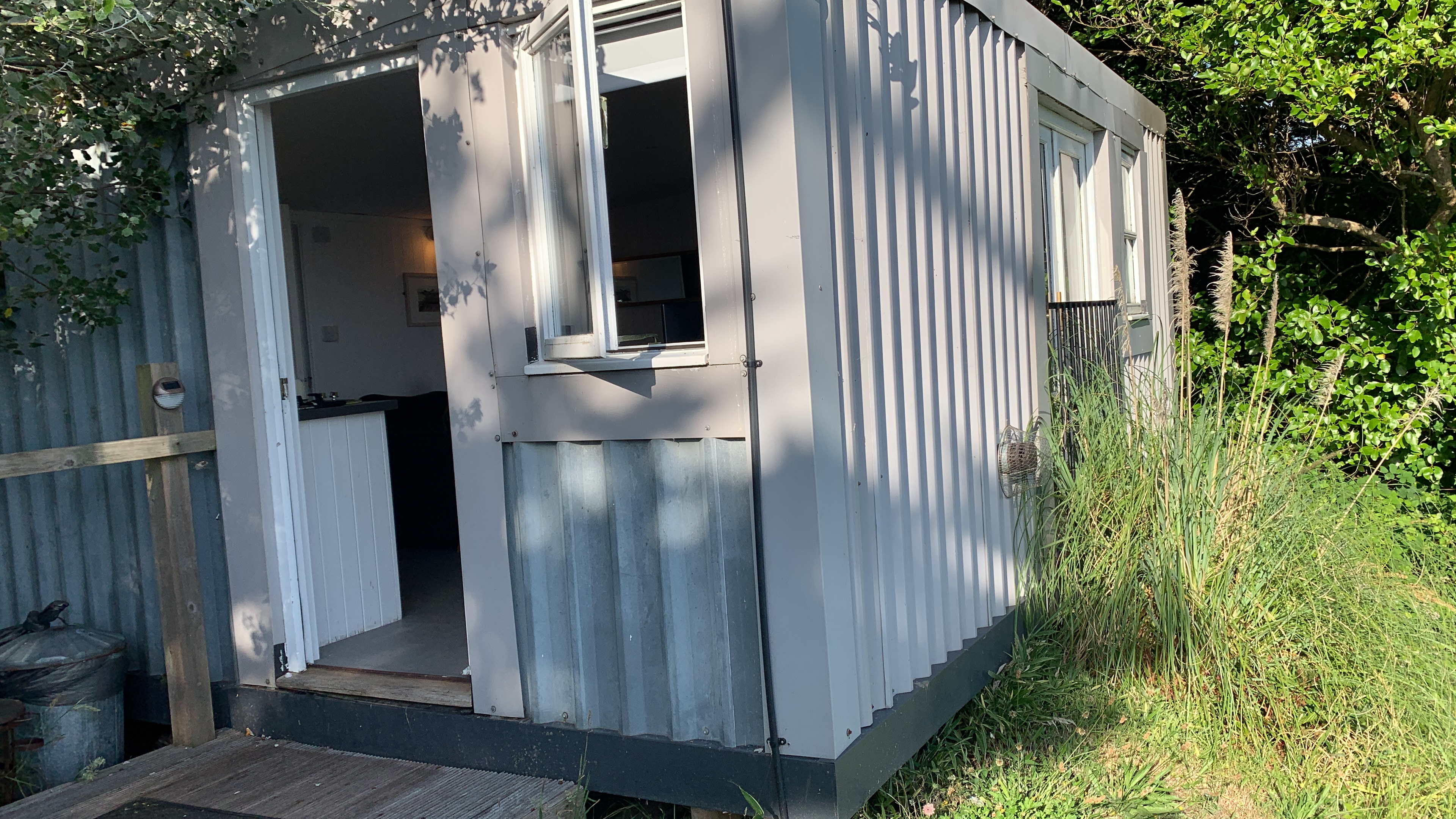
I plugged the postal code into Google maps and we walked down the road a bit and up a massive flight of stairs to the AirBnb.  The apartment is a shipping container converted into two rooms and a bathroom.

The view from the top was amazing but our excitement was short-lived because when I set up my computer I was seeing massive data loss to common sites (around 80% packet loss) and live voice/video calls were impossible.


I had some trouble communicating this with the owner.  When the household mostly uses the internet for web browsing, social media and for streaming movies the software is pretty good at buffering to minimize the effects of intermittent loss of data so they might not even be aware of the problems.

In this case we were told it had been fine for other visitors some of whom had worked there before.  They offered to reset the router in their house down the hill and we could reset it at the top afterwards.  They were using an extender to get their internet access up to the shipping container on the hill.

I realized after everything was reset with no sign of improvement that we would have to find somewhere else to stay before my work started the next day at 2pm.

We found another AirBnb in a small town in Devon on the other side of Plymouth and we took the bus ride in the morning after arranging to get reimbursed for all but the one night.  

We almost missed the bus because we were about 2min walk from the bus stop when it drove past us.  The driver noticed our luggage and my alarmed expression when he drove past and he stopped the bus at the next corner for us to catch up and get in.

Considering that two cars coming towards each other have trouble, the bus makes for an even more interesting ride.  I told the driver at the end that he deserves danger pay!


Our stop in Plymouth to pick up the car was illuminating.  A bus driver at the ferry stop was kind enough to offer us a ride up the hill free of charge to get to the correct bus stop for where we needed to go.  This was the third act of kindness from strangers since we'd arrived over here (4th I suppose if you count the man in the bar who told us where to find food)!

It was raining for much of the time we spent in Plymouth.  The area we stopped in for coffee was marked on the map as an area of greenery but the closest it gets are the trees growing in the middle of the concrete paving.

Once we had our car we made our way on a 2 hour drive to the small town of Brixham in Devon in the area called Torbay.

I was interested in how the people of Devon and the Cornish get on and it turns out there are a few details to their rivalry although these are mostly described as light-hearted.  The most well known is whether you put the jam on your scone before the clotted cream or the other way around.  It turns out that Anne and I disagree on this point which surprised me.  I can't imagine how you spread jam on top of cream!  

One morning we stopped at a coffee shop full of memorabilia from a passenger steam ship line (Cunard) that used to ferry mail and passengers internationally in the 1950s-60s.  As of 2022 they are the only shipping company still offering a passenger service between Europe and the USA

We ordered a cream tea for 2 and one of us put the jam and cream on the scone in the correct order.


The town of Brixham is a quaint fishing town enclosing a small harbor.

We were able to go for a few walks around the town which has some obviously tourist-oriented shops.


The streets are narrow here as well, with parking fairly hard to find.  We were able to park our car across the street from our AirBnb for the week but it was tight up against the curb and along with the other cars parked there blocking half of the road forcing cars to single file in both directions.


There is a section of a hiking trail reachable from the city.  The trail is called the South West Coastal path and Anne had read about it in a book called "The Salt Path" by Raynor Wynn who hiked this trail with her husband after financial ruin and after his terminal health diagnosis.

We decided to find it and walk for a stretch along it.

The coastline if rugged but very beautiful.

There are stretches that run on the streets and paved paths of the towns where the path takes you through a town.  Our walk was half in the country and half in the town so we got a feel for both.

After a week in Devon we headed back to Torpoint, across the ferry, this time in the rental car and stopped again at the restaurant where we had been treated so kindly.  

The restaurant is called Woogies and we had a meal there that rated up with the best restaurant meals we've had on our travels.


From Torpoint our sights are set a small village within walking distance of Penzance in a bay on the most south-western stretch of England.